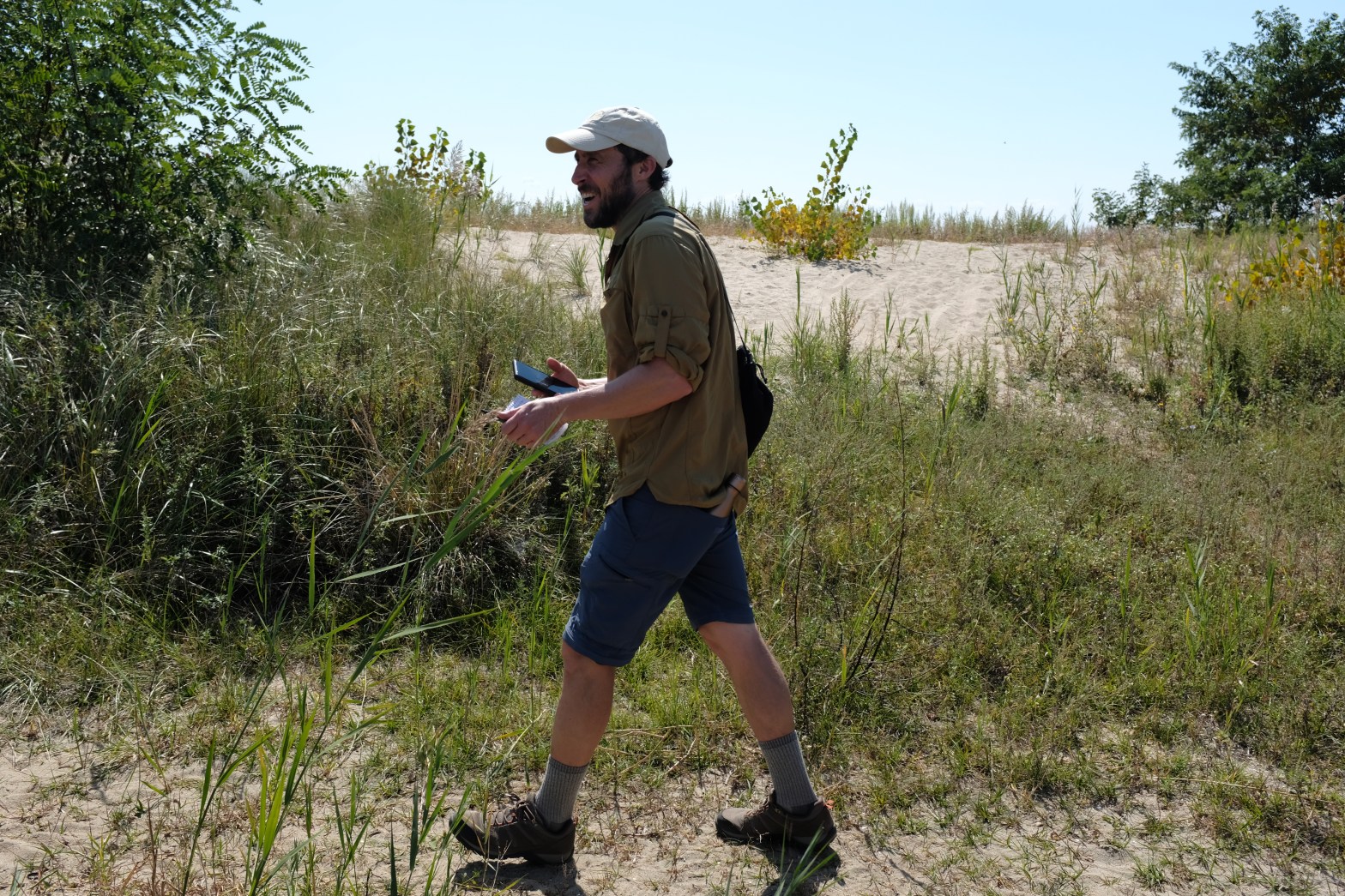
On Saturday, September 21, 44-year-old Matt Green hopped over the finish line of his obsessive, years-long quest to walk every street and pedestrian path in New York City, a journey of almost 10,000 miles.
It ended at the corner of Armstrong Avenue and Amboy in Staten Island—the same randomly selected street where he started his walk on December 31, 2011. To celebrate, his girlfriend handed him a shot of whiskey in a glass emblazoned with the words “Let’s Do This” in glitzy gold lettering, something that Green had, naturally, found while walking in the city; someone else handed him a giant congratulatory citation signed by the mayor, which he read aloud. (“I applaud his awesome achievement and his commitment to showcasing the excitement and wonder that can be found throughout our great metropolis,” the mayor wrote.)
Amid cheers from the gathered crowd of friends and admirers, someone tapped Green on the shoulder to draw his attention to a newly installed commemorative plaque honoring his achievement. Tears welled up in his eyes and spilled onto his cheeks, still damp with sweat. “I’ve been the one reading those signs the past 12 years, the weird little signs that no one pays attention to,” Green said. Now, he was part of the landscape, someone that another New Yorker might learn about while on a stroll. Turning to embrace his mother, Miriam, he said, “I’ve been worried about missing a turn all day, and now I’m feeling rather emotional.” It was a characteristic understatement from Green, who, despite devoting 12 years, eight months, and 21 days of his life to his walk, still can’t quite explain why he did it.
“I don’t have an answer to that question,” he told me. “I did it because it sounded like a cool thing to do.” He continued: “Something that’s important to me is that people not feel like they have to be able to come up with an explanation for the things they’re compelled to do. There are probably a lot of people who would have done something really interesting, but it just seemed too weird, and they couldn’t explain why they were going to do it, and that seemed intimidating or something. I don’t know why, and I never really tried to come up with a nice-sounding explanation.”

I had known of Green’s quest for some time—I even once flippantly referred to it as “slightly repellent,” mostly because it sounded like a logistically tedious nightmare. So, when I heard from a mutual friend that it was ending, I asked to tag along, hoping to gain some understanding on what would possess someone to embark on such an undertaking, or, at the very least, to learn what he got out of it.
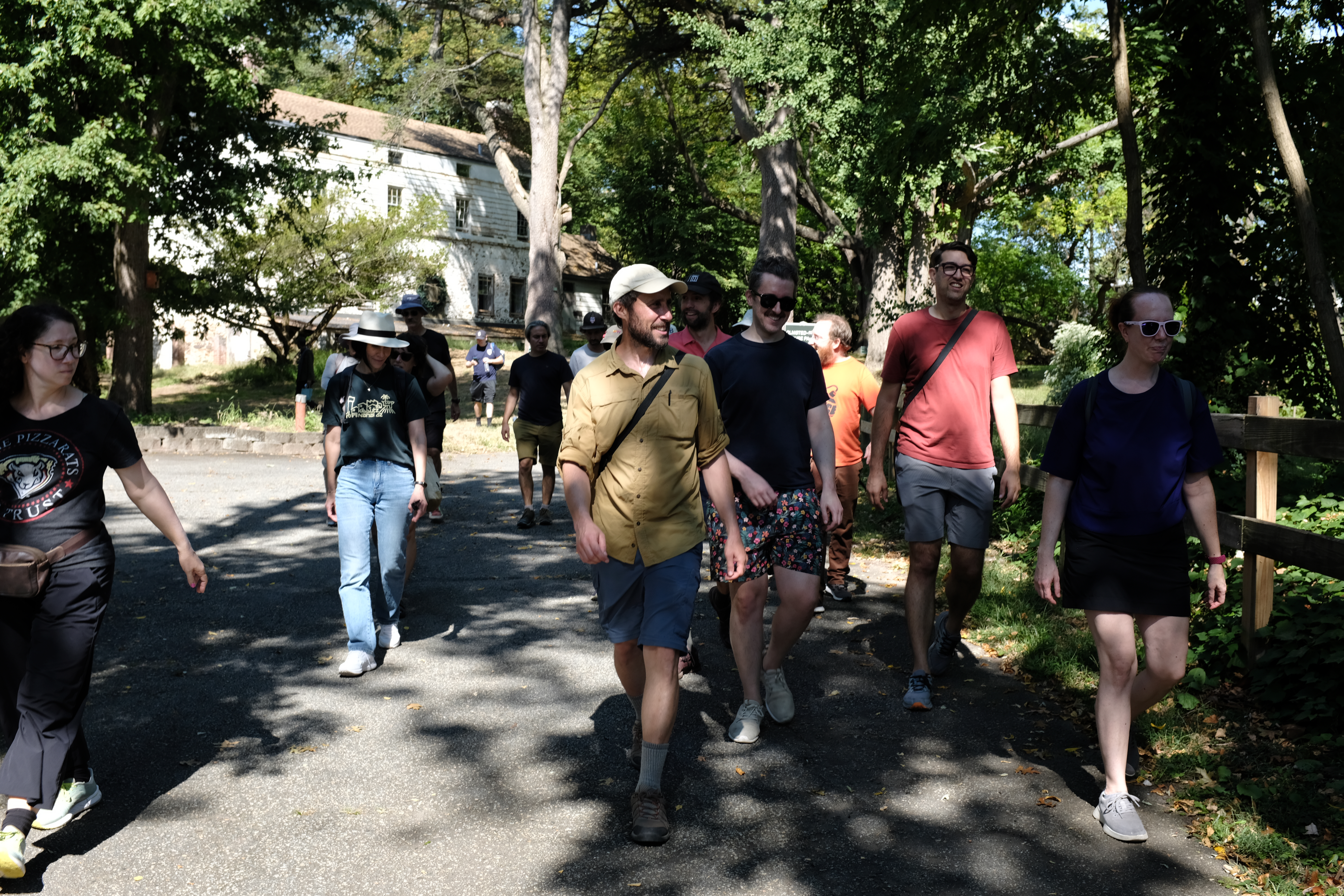
Earlier that Saturday, I had met Green and more than a dozen of his friends outside the Annadale train station, all of whom were there to accompany him on the last segment of his walk. Our starting point was just a mile and a half from the finish line, but Green’s circuitous 10-mile route, written out turn by turn in a little notebook, would take us five hours. The group included Jeremy Workman, the friend who made a documentary about Green called “The World Before Your Feet“; the friend who made Green’s website detailing his walk; Green’s brother; and some people who had met in the late aughts, when Green led a weekly walking group called Hey I’m Walkin’ Here.
One couple there on Saturday met at a frisbee game where they heard about Green’s walks, and were the only people who thought, “That sounds like fun, let’s go.” Green later officiated their wedding.
Liz, half of that aforementioned couple, greeted a fellow walker by quipping that she hardly recognized him with his hair short. “You finally grew up!” she teased. “I would have taken that as an insult,” Green cut in. “Not that it took so long, but that you grew up!”
Green has a puckish, eternally youthful demeanor, in spite of the grays peppering his beard and the crow’s feet that spring up around his eyes when he smiles. Growing up is something it seems Green has been avoiding—at least its most conventional trappings—since quitting his job as a civil engineer in 2010. That was the year he decided to walk across America, from Rockaway Beach in Queens to Rockaway Beach in Oregon, a journey that took five months. It was after finishing that walk that he decided to keep on walking, only this time, his path would be through all of New York City.
When Green started, he told the New York Times it would take more than two years of full-time walking to complete his quest. At that time, he had no fixed address, but moved around the city cat-sitting and house-sitting or sleeping on friends’ couches, subsisting on less than $20 a day. He kept a blog with photos and sometimes short histories of the things he saw each day.
Green isn’t the only New Yorker to attempt to traverse the entire city by foot. William Helmreich, a CUNY sociologist, walked “almost” every street in New York City before penning the book “The New York Nobody Knows.” By many accounts, Green has been even more dogged, traversing alleys and private streets that Helmreich skipped. (Green and Helmreich were able to meet and walk together before Helmreich died in early 2020 from COVID.)
The difference is clear in their estimated mileage: Helmreich walked more than 6,000 miles; Green’s best estimate is that he’s walked 9,954 miles, give or take a few. (The discrepancy partly comes from the fact that Green at times would repeat some stretches, in order to cover every block.)
If Helmreich walked the city to understand it, and to explain it to others, Green’s goal is to merely experience it, largely for himself. (Green’s journey has, however, inspired a subreddit for people who want to follow in his footsteps.) Garnette Cadogan, a lecturer in urbanism at MIT who came down from Boston for the walk, said Green was more “humble” in his approach to walking the city.
Even his blog isn’t tailored for others, Green said—he doesn’t care about metrics, or how many people read it. “It frees me from having to think about anything other than what I’m looking at. I can just truly experience it as myself, without any kind of thought for it having a particular purpose or use,” he said.
Green compared his approach to walking to the way people are trained to look at artwork, to notice the light and the details: “And in doing that, you just start to learn things about yourself, and to notice what moves you.”
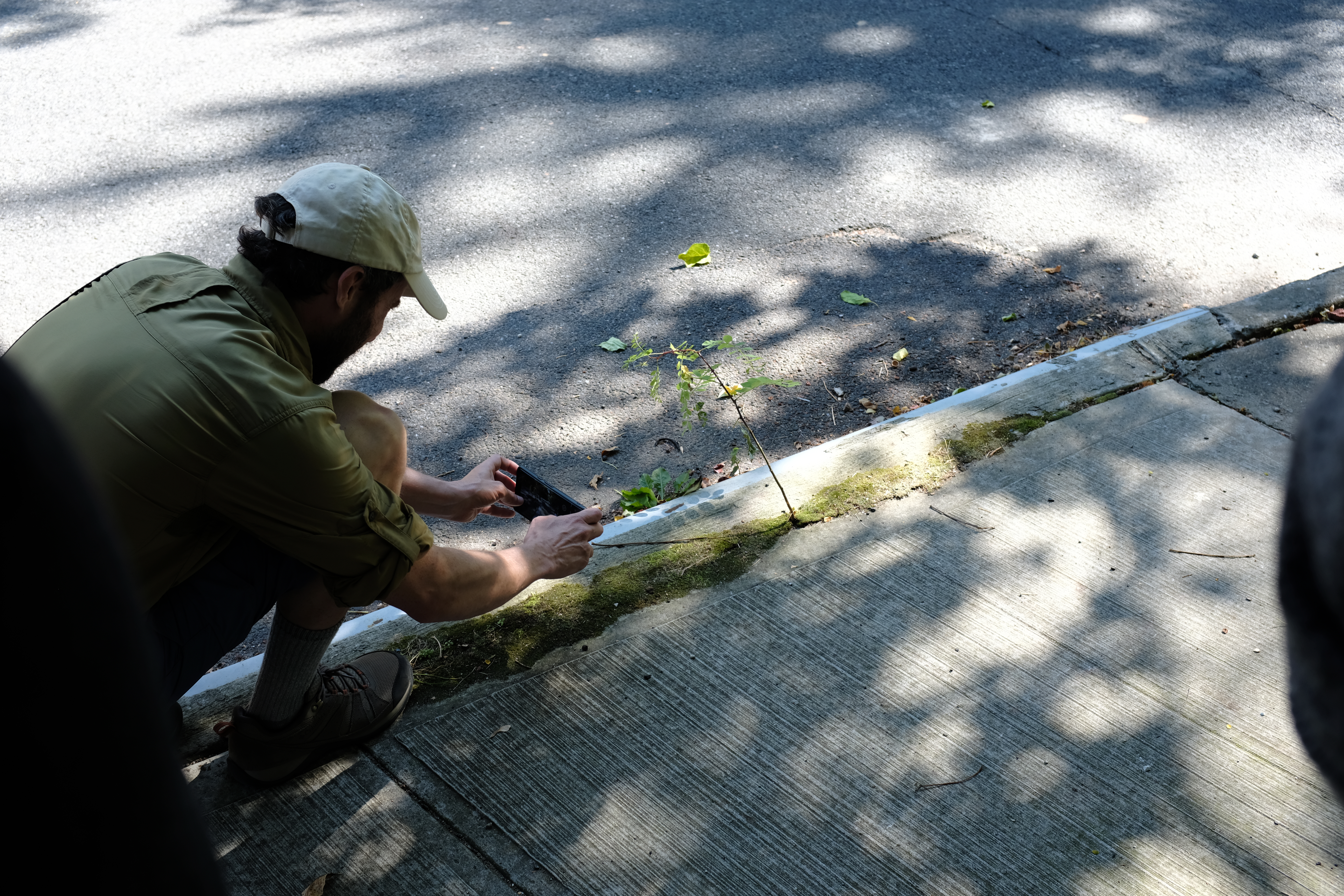
As we walked, Green would regularly pause to take a photo of something that moved him or caught his eye, shooing the rest of us out of the frame. This included: a small tree growing out of a sideway crack; a 9/11 memorial (he has a collection of these); and the hood of a car covered in bird droppings, which one of his friends referred to as “a Matt Green special.”
I started to ask another question but Green told me to hold that thought—he wanted to guide the group up a short driveway leading to Tosomock Farm, Frederick Law Olmsted’s former residence and living laboratory, which was purchased by the Parks Department in 2006.
We poked around the decaying building for a bit, relishing the shade. One friend of Green’s asked if he had saved the Olmsted residence for the last walk. No, he replied. “These are just completely random blocks that I happen to have left,” he said.
That brought him to his grand theory of walking, if you can call it that (Green probably wouldn’t): “We sometimes think about the city as if the city itself is interesting or not interesting, different parts of it are interesting or not interesting. But we, as the observers or participants of the city, as we’re walking around, have an equal responsibility for whether it’s interesting or not.” He continued: “If you have a group of 23 or however many people walking around, if they are curious people, then the walk will be interesting. And if they’re not interested in anything, then the walk will be boring, no matter what we walk by.”
Over the past few years, Green’s walk has become something he does, not the only thing he does. During the pandemic, he had to take an extended break, as he moved back to Virginia to live with his parents. (Naturally, he walked every block in his hometown.) After returning to the city, he began gradually settling down, downshifting into a new phase of his walk, and of his life. He began dating someone new two years ago, and he is now working as an assistant for the Colombian writer Jaime Manrique, who was at the finish line. He and his girlfriend have been living together—in their own apartment—for almost a year now. “It’s a big change in some ways, but it’s also just a natural step,” he said.
Green hopes to eventually do something with his years-long backlog of urban photographs and accompanying research, although he said it would take decades to work his way through the existing material. He’s also fantasized about starting a boutique elopement service where he guides couples to cool and weird places in New York City, and marries them there.
But all of that was part of the future, not the present. As we neared the finish line, I asked Green if he thought he’d be sad when it’s over. He looked at me for a moment, bright-eyed, then smiled and laughed. “I don’t know,” he replied.


 Jessica S. McKenzie