On a warm Sunday morning in early June, I boarded a train in central Athens headed towards Kifissia, an affluent suburb to the north of the city. We had just rattled away from the station for the Athens Olympic Sports Complex in Marousi when I spotted a spire of smoke rising in the distance, behind a ridge of mountains.
It was quite the coincidence, since I was on my way to see Giorgos Dertilis, the head of the Volunteer Forest Firefighting and Rescue Team in Ekali, part of the Kifissia municipality.
When Dertilis met me at the station a short time later, I asked him about it. He wrinkled his brow at me in surprise and hopped on the radio to learn more. Back at headquarters, it was confirmed: Someone had been burning tires, probably to recover scrap metal. There’s a blanket ban on outdoor fires during Greece’s fire season, which extends from the first of May to the end of October, but that doesn’t stop people from testing fate. In July 2018, a man burning brush in his yard kicked off a deadly conflagration that swept through the seaside resort town of Mati, 20 miles from central Athens, killing 104 people.
Although the number of wildfires recorded annually in Greece has decreased since 2000, wildfires are getting larger, burning nearly 1,500 acres more on average with each passing year. In 2023, a wildfire broke out in the Evros region in northeastern Greece, near the Turkish border. It burned for more than two weeks, eventually scorching more than 237,000 acres—the largest recorded wildfire in Europe since the European Forest Fire Information Service began keeping track—and killed 20 people, including 18 Syrian asylum seekers.
Fires are also becoming more common outside of the traditional fire season, with the number of fires between November and April increasing by 47 percent since 2012; these fires are also burning larger areas with each passing year. There are myriad factors at play in these dangerous trends; two of the biggest are land-use and climatic changes.
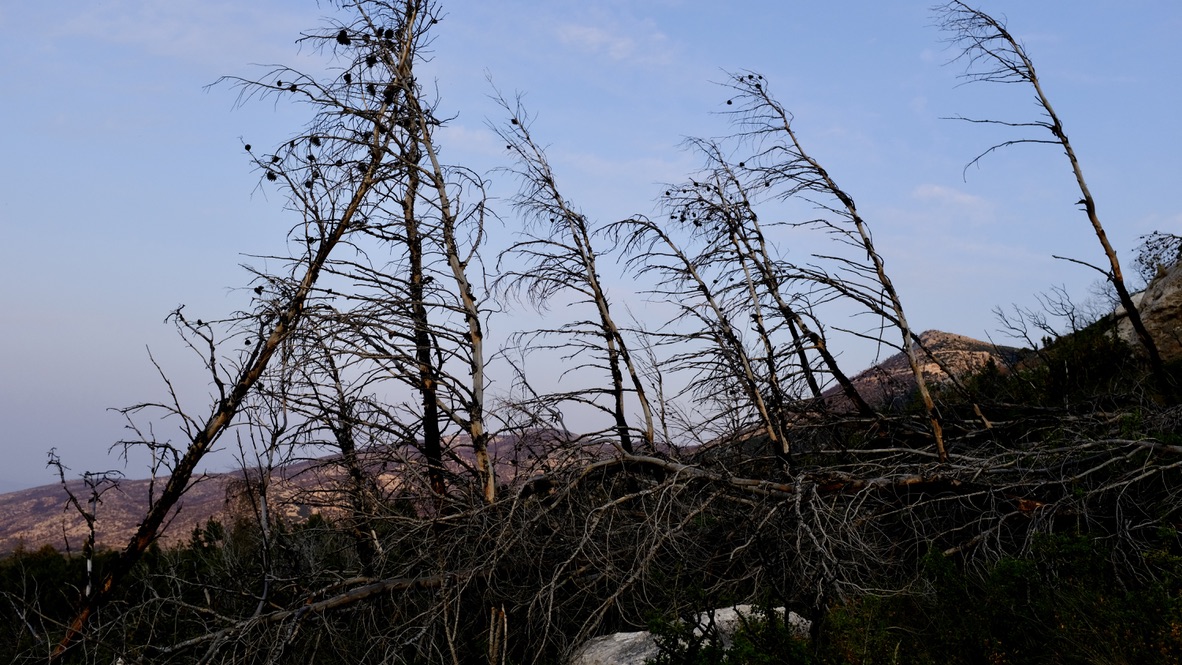
I was in Athens for a little over a week, which was just enough for me to get a taste of the hot and windy climate that can nurture any stray spark into an inferno. I climbed to the top of the Acropolis, sweating in the early evening sun with other tourists. I spent a day with volunteer firefighters, driving around to see the burn scars from blazes they battled last summer. I was buffeted by gusts while visiting an observatory that narrowly escaped the flames last year. I hiked through Parnitha National Park and saw new pine trees growing in the shadow of blackened tree trunks. The threat of fire seemed ever present, especially at the edges of the city, where drones hovered on high-risk fire days, part of Greece’s burgeoning early-detection program.
Some of my taxi drivers, upon hearing of my interests, regaled me with tales of heroism and loss: One told me of a friend who lost his house in a wildfire last year. Another said he evacuated his parents from his childhood home and then went back to personally ensure the building did not burn; the fire came into their yard and consumed all the vegetation, but the house is still standing.
I was left with the impression of a city and country on edge—doing its best to adapt and cope, but in general, and like many other fire-prone regions, ill-prepared for the kind of extreme wildfires that climate change is unleashing. As I was finalizing this story, wildfires driven by gale-force winds broke out at multiple locations around Athens, forcing evacuations, as other fires raged to the west in the Peloponnese and on multiple Greek islands.
 Jessica S. McKenzie